
The Long Bridge Newtown
A wooden bridge across the Severn, close to the site of the Long Bridge was recorded as early as the fifteenth century.
A wooden bridge across the Severn, close to the site of the Long Bridge was recorded as early as the fifteenth century.

This painting by Edward Salter of 1879 shows Newtown’s steam age well under way. Several factory chimneys are belching out thick black smoke from their boiler houses, and an express steam locomotive approaches the railway station.

A close look at how the flannel industry in Newtown changed in the early stage of its development as a manufacturing centre.

Amongst the time-worn gravestones in Newtown's long abandoned riverside church of St Mary’s lies one which provides the outline of a family’s tragic story. The memorial is inscribed with the name of Thomas Syars, one of the town’s many flannel manufacturers

The first floor windows of the Royal Welsh Warehouse offered a commanding view of the length of Broad Street, the Long Bridge and Crescent Street in Penygloddfa beyond

The key to an understanding of why Newtown became an important centre for the manufacture of flannel lies in its ancient water mills.

Pryce Jones is regarded as one of the early pioneers of mail order, paving the way for our modern on-line world. Just like today’s internet companies, he relied upon advertising to stimulate sales and he was one of the first retailers to send out catalogues to his customers. But when exactly did this happen?

For some forty years, a 1878 panorama painting of Newtown hung on a wall in

A glimpse into the life of the individuals who may have lived in the back-to -back cottages which were part of 'our museum'

At the end of the 18th Century, Newtown was still a very small town with a population no greater than a modern-day village. Yet, within the space of forty years, it had developed beyond its medieval boundaries and its population had grown to 7,000 people. In the process it had acquired the epithet of ‘The Leeds of Wales’.

In the 1960s a number of ‘weaving factories’ such as this one were being demolished in the town, but the heritage value of the building was recognised and the surrounding area of Penygloddfa was declared a conservation zone.

Up until the end of the eighteenth century, the production of woollen flannel had been a small-scale cottage industry carried out in the homes of the rural population. In the early 1800s that all changed.


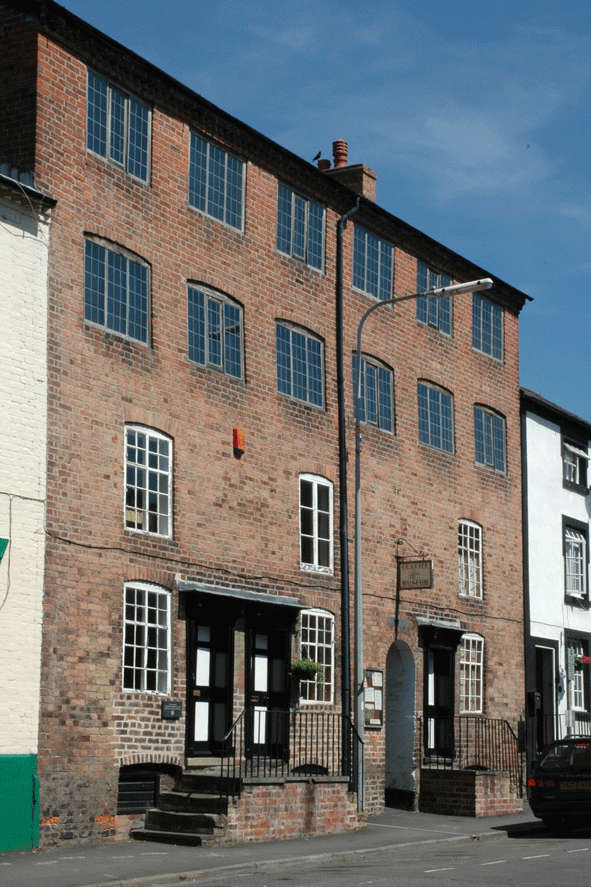

Bwthyn ein gwehydd wedi'i addurno ar gyfer y Nadolig
Our weaver's cottage decorated for Christmas


If you missed our 2023 exhibition, we have made some of the information boards available for you, which complement the You-Tube video available on the link below.
They feature Amelia Ray, who ran a successful draper's shop in High Street, Newtown for a decade during the 1870s where the shopping experience was changing rapidly with the coming of the railways and the postal service. We have a large collection of papers about her business which tell us about her customers and her suppliers. She was in direct competition with Pryce Jones whose shop was nearby until he moved his business to the new Royal Welsh Warehouse near the station in 1879.
To catch up on what you missed, head for the Past Exhibitions where you can see several of our past exhibitions listed. NB these links work better if you have a full screen on your computer, or a tablet device. You will be surprised by some of the interesting jobs that a draper's shop took on at the time. We have an excellent Exhibition Guide, a few copies of which are still available if you contact us, which tells more of the story.
If you would like a short preview of the exhibition, check out this YouTube link.

This is a FAQ description. Add more detail about this service, such as benefits, appearance, components and value
This is a FAQ description. Add more detail about this service, such as benefits, appearance, components and value
This is a FAQ description. Add more detail about this service, such as benefits, appearance, components and value
This is a FAQ description. Add more detail about this service, such as benefits, appearance, components and value
This is a FAQ description. Add more detail about this service, such as benefits, appearance, components and value
This is a FAQ description. Add more detail about this service, such as benefits, appearance, components and value










This will run for three weeks. It will showcase the results of their work, is for everyone interested in the art and craft of making constructed and embellished braids and narrow bands

During the Braiding exhibition, there will be demonstrations and a workshop where participants can learn some of the skills involved in this great craft.
The demonstrations are free, but there will be a charge for the workshop. Details on the Events page.

Wonderwool Wales is the premier Wool & Natural Fibre Festival in Wales and is held annually on the last weekend in April at the Royal Welsh Showground, Builth Wells, Powys.
The festival celebrates the green credentials of Welsh wool and its versatility as a material for creative crafts, designer clothes, home furnishings and more.
The Museum will have a stall at the show and will look forward to seeing you there.
A great day out.


Please Gift Aid your donation if you are eligible.


volunteer@newtowntextilemuseum.co.uk
We all need friends. The Museum needs Friends too. We encourage you to join the NTM Friends group to help us keep the Museum open and vibrant into the future. Check out the How to Help page for details.